
 ← All news
Revolutionizing Education in the Era of Generative AI
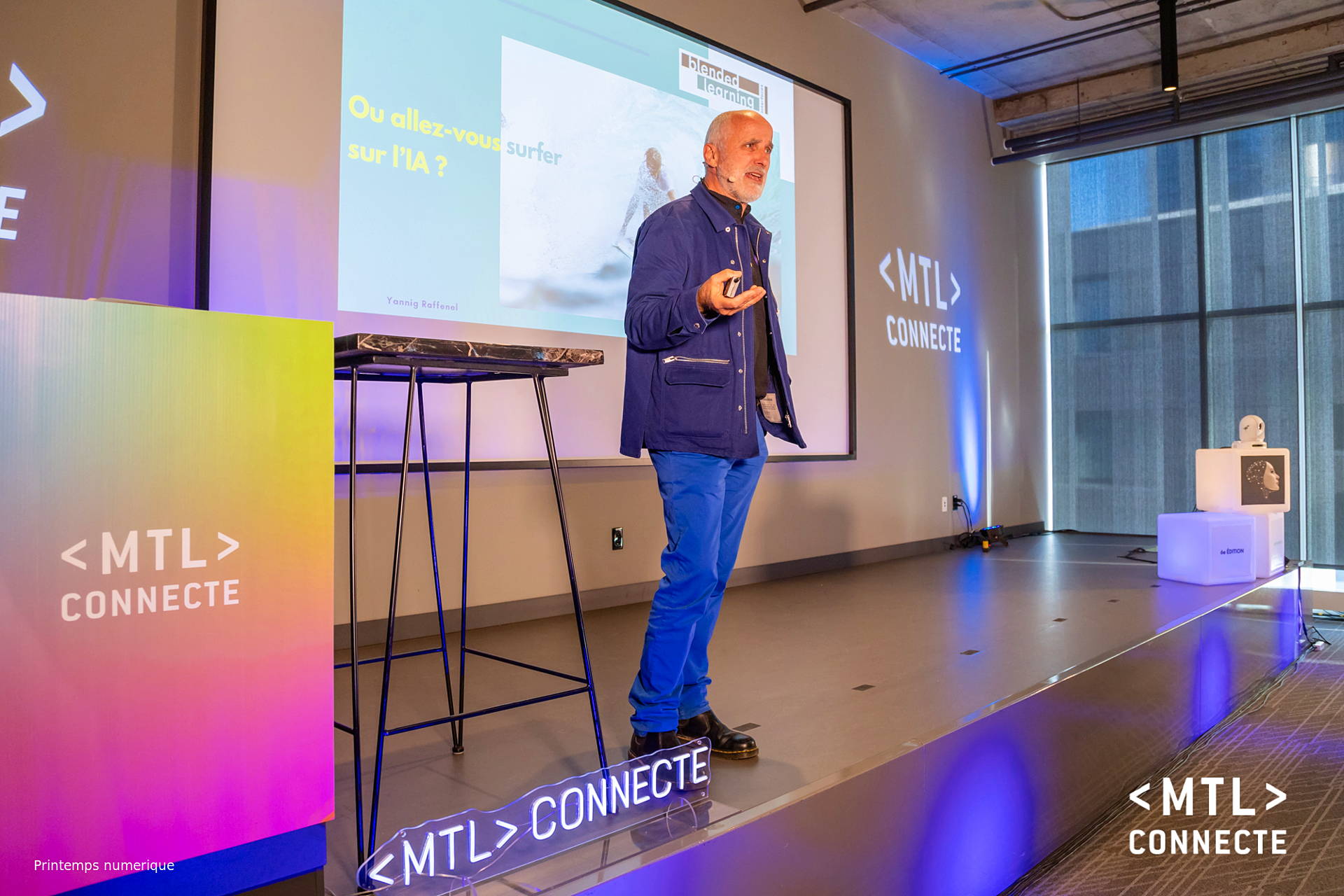
In a world where technology is evolving at a rapid pace, artificial intelligence (AI) is gradually redefining educational practices. This change affects both learning methods and the role of teachers and educational institutions. During MTL connect 2024, Yannig Raffenel, an education and technology specialist, explored these issues in his conference “Revolutionizing Education in the Era of Generative AI.”
5 Key Takeaways from Yannig Raffenel’s Conference
1. The Challenges and Opportunities of Technology in Education
According to Yannig Raffenel, the rapid arrival of new technologies in education will disrupt teachers and institutions. He states that the main challenge is not simply to digitize existing content, but rather to completely rethink learning methods to adapt them to technological reality and the expectations of learners.
2. The Importance of Hybrid Learning Models
Approaches that combine in-person and digital learning, known as hybrid models, are the most promising. These formats, which often include human support such as mentoring, achieve course completion rates exceeding 60%, compared to only 15% for fully online courses.
3. Preparing Skills for the Future
In a world where jobs are constantly evolving, transferable skills such as creativity, adaptability, and problem-solving are becoming essential. Yannig Raffenel also highlights the importance of immersive tools, such as virtual reality, for engaging and practical learning experiences.
4. Lessons from the Health Crisis
The pandemic acted as a catalyst, accelerating the transition to distance learning. However, it also highlighted its limitations, particularly the sense of isolation among learners and the need for human interaction.
5. Neuroscience and Active Pedagogies: The Key to Success
Integrating advances in neuroscience into educational pathways improves how learners absorb and retain information. This research shows that repetition plays a key role in consolidating knowledge, especially when it is embedded in concrete contexts directly related to the learners’ reality. This helps to better anchor concepts in their memory and facilitates understanding.
Additionally, Yannig emphasizes the importance of active pedagogies, such as project-based learning, which rely on the active participation of learners. These approaches prompt them to immediately apply their knowledge in practical activities, which stimulates their engagement and strengthens their ability to use what they have learned in real-life situations.
This conference offers an inspiring vision for reconciling technology and education while placing humans at the heart of learning systems. To discover all the details of Yannig Raffenel’s presentation and explore concrete examples of these transformations, don’t miss the full video of his conference.
🎥 Watch Yannig Raffenel’s exclusive conference